
Begin with what has been observed
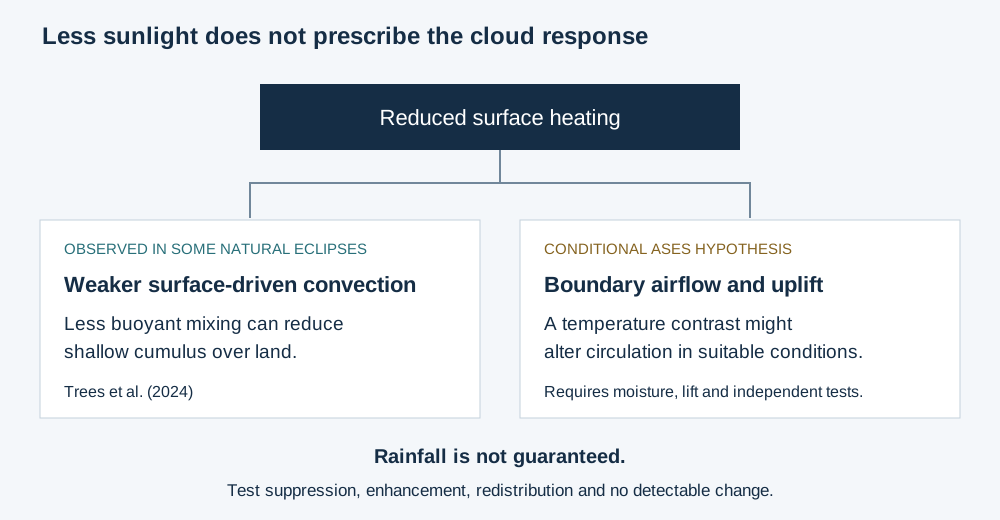
Trees and colleagues (2024) combined corrected satellite observations with simulations to study clouds during solar eclipses. They reported shallow cumulus dissipating over cooling land, with a response beginning at around 15% solar obscuration in the studied cases. Reduced surface heating can weaken the rising thermals that help sustain these clouds.
This result challenges a simple claim that less sunlight must create more cloud. It does not establish that all cloud types, places or engineered shading configurations behave identically.
Cooling is only one part of a rain mechanism
Cooling can raise relative humidity without adding water vapour. Rainfall also requires enough moisture, suitable lifting, cloud-particle growth and dynamics that sustain the process. Stable air may resist lifting, and background winds can move a response away from the shaded area.
A complete study would track surface heat fluxes, vertical stability, moisture transport, cloud depth and precipitation inside and outside the proposed footprint. A cloud image alone cannot show that regional rainfall has increased.
The cold-pool and rain-ring hypothesis
The book asks whether a cooled region could generate temperature contrasts and boundary airflow that, in some environments, support uplift. The proposed “rain ring” is a hypothesis to test. A symmetric ring, organised deep descent or rainfall at the boundary cannot be assumed from surface cooling alone.
- Test cloud suppression as well as enhancement.
- Compare the intervention with a matched no-shadow atmosphere.
- Assess asymmetry from wind, terrain and coastlines.
- Check whether rain is redistributed from another location or time.
- Retain null and adverse findings.
A useful result may be a limit
If independent models disagree, if a signal is smaller than background variability, or if a mechanism depends on unusually narrow conditions, those findings should change the claim. The next step is a better experiment or a narrower hypothesis, rather than an asserted weather benefit.
Sources & further reading
These sources establish background context. They do not certify the ASES proposal or demonstrate its proposed applications.
ASES remains a research proposal. Atmosfrustology is the author’s proposed framework. No operational climate-control capability is established by this website.